Products
Uncle John’s Famous Custom Straps
Uncle John’s Famous String Goo
Uncle John’s Famous Tortoise Shell
Charlie Christian Style Pickups
Uncle John’s Famous Custom Straps
Our straps are handmade locally from the finest leather. That means hand stitched, hand carved and embossed by hand.
Each strap is unique, and can be custom made to order. Here is just a sample of what is to come.
Come in and find what we can create for you, prices start at $60.00
Uncle John’s Famous Leads
The Lead that will last a gazillion gigs! No longer must you suffer leads that create annoying scratching, embarassing crackling or even worse… no sound at all. There is now nothing to stand in between you and your page in music history, so stradle that rock ax, crank every knob you can find up to 11 and prepare to unleash your triumphant blaze of rock ‘n’ roll glory upon the masses!We make all of our leads right here in store out of the highest quality components the industry has to offer, so we can give you the guarantee if it does ever break, we’ll fix it or simply replace it, free of charge.
12ft* Lead RRP $45.00
20ft* Lead RRP $55.00
Custom lengths can be made to order
Uncle John’s Famous String Goo
The Goo with a gazillion uses! It’s a string preserver, string and hardware lubricant and polish for your acoustic or electric guitar, bass, mandolin, banjo, bozouki, sitar… WHATEVER!!!
It works by neutralising the corrosive, alkaline solution that is human sweat. As it does this it also coats the string protecting it from the harmful effects of oxidisation.
And this stuff actually works. It makes strings last up to 4 times longer.
RRP $25.00
The Tone Bloc
These little beaut’s are made from Brazilian Bloodwood, yep you heard, Bloodwood, they sit underneath the bridgeplate, held in by the strings and can bring a dull guitar back to life. They amplify the mid range of the soundboard giving your guitar that extra 10% everyone is looking for. This particular one has a brass resonator piece in ‘er giving some much needed top end as well.
All that in one little piece of wood phew
Uncle John’s Famous Tortoise Shell
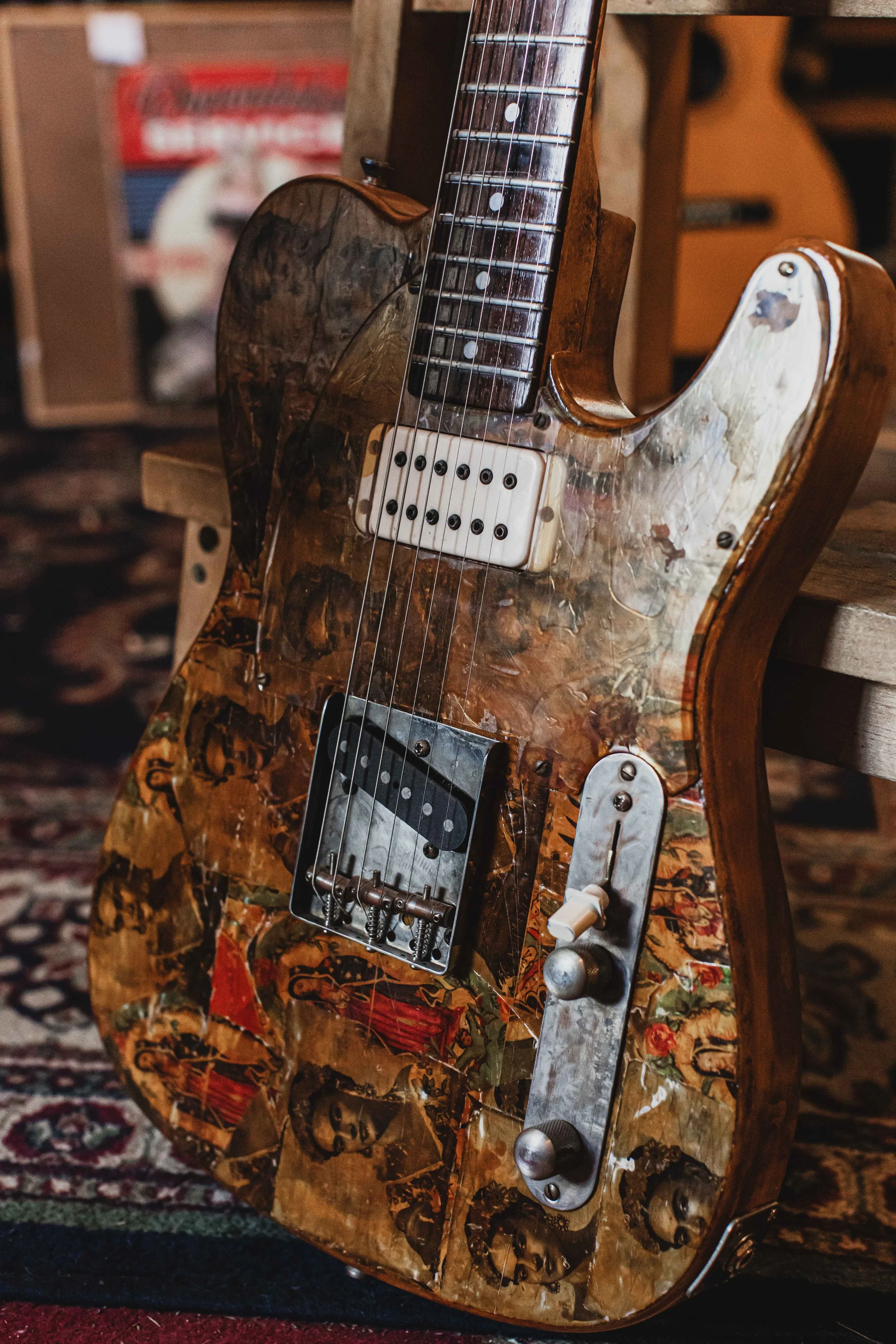
So our boys Matt and Luke got funky with some clear perspex and a host of nitro cellulose / stain mixtures to create the tortoise shell delights you see before you.
We even utilised the stuff in one of our banjo pick-up systems (see photo), with pleasing results.
Scratchplates and many other accessories are made to order. This is just a sample of what we can do.
We started creating our custom tortoise shell creations for a couple of reasons. Firstly, it is very difficult to import tortoise shell as it is flammable, and secondly we have been increasingly unhappy with the range of tortoise shell scratchplates available, we feel they just don’t do a fine classy instrument justice.
Compensated Nuts
Ever driven yourself insane trying to get the open chords of your guitar to all play in tune and then once you’ve found an acceptable compromise you find the bar chord suck ass? Well this can help. When you look at your guitar, do you notice that the bridge saddle/s are further away from the neck on the bass side and closer to the neck on the treble side? This is called compensation and it is designed to compensate for the thickness of the strings so that they are as close to being a perfect octave at the 12th fret. The 1000,000.00 question is how do you get them to be in perfect pitch over the rest of the finger board? Answer. You can’t, OR…….you can if you intend having individually calibrated frets for each string (that’s roughly 132 mini fret lengths). And that isn’t easy to do, although I really would love to try one day. Now having said this, I would be remiss if I didn’t point out that a little bit of dissonance is not a bad thing in any musical instrument, because without dissonance you would not have tone (wanna know more? Please ask). Now back to the compensated nut. It works in the same way as the bridge saddle/s, only it does it from the other end. Now there has been an upsurge of interest in this type the nut mainly through the marketing of several companies claiming to have virtually invented it themselves. Sorry fellas, no disrespect but luthiers going back as far as the 17th century were applying the same idea to gut stringed instruments. Musicman and ESP also have this concept on many of their guitars. The nut is especially useful for those folks who like to use a capo and also you metal heads who love nothing more than a guitar tuned down to B. The average price of this modification is $75.00 and for many it will be money well spent.
Handmade Brass Bridgepieces
Up until recently we, like most guitar repair shops replaced bass saddles and telecaster bridge saddles with the best bridge saddles we could find. However I’ve never been that happy with the type of brass used, nor the tone it produced. I researched the historical “why’s” and “where fores” of this and found the most interesting thing. The original brass used by the likes of Fender back in the 50’s was actually a softer compound than that which is available today. This softer brass was cheaper and more available in post war USA owing to the on going rationing in the mineral resources sector. Now here’s another even more interesting thing. The brass “D” mould strips used in old European Piano’s are also a softer type of brass…..Do you see where I’m going here? The softer compound actually gives more sustain, has a woodier, warmer tone and best of all we’re all doing the planet a favour. These saddle sets are on average 140.00 plus fitting
Custom Girlie Pinup Decals
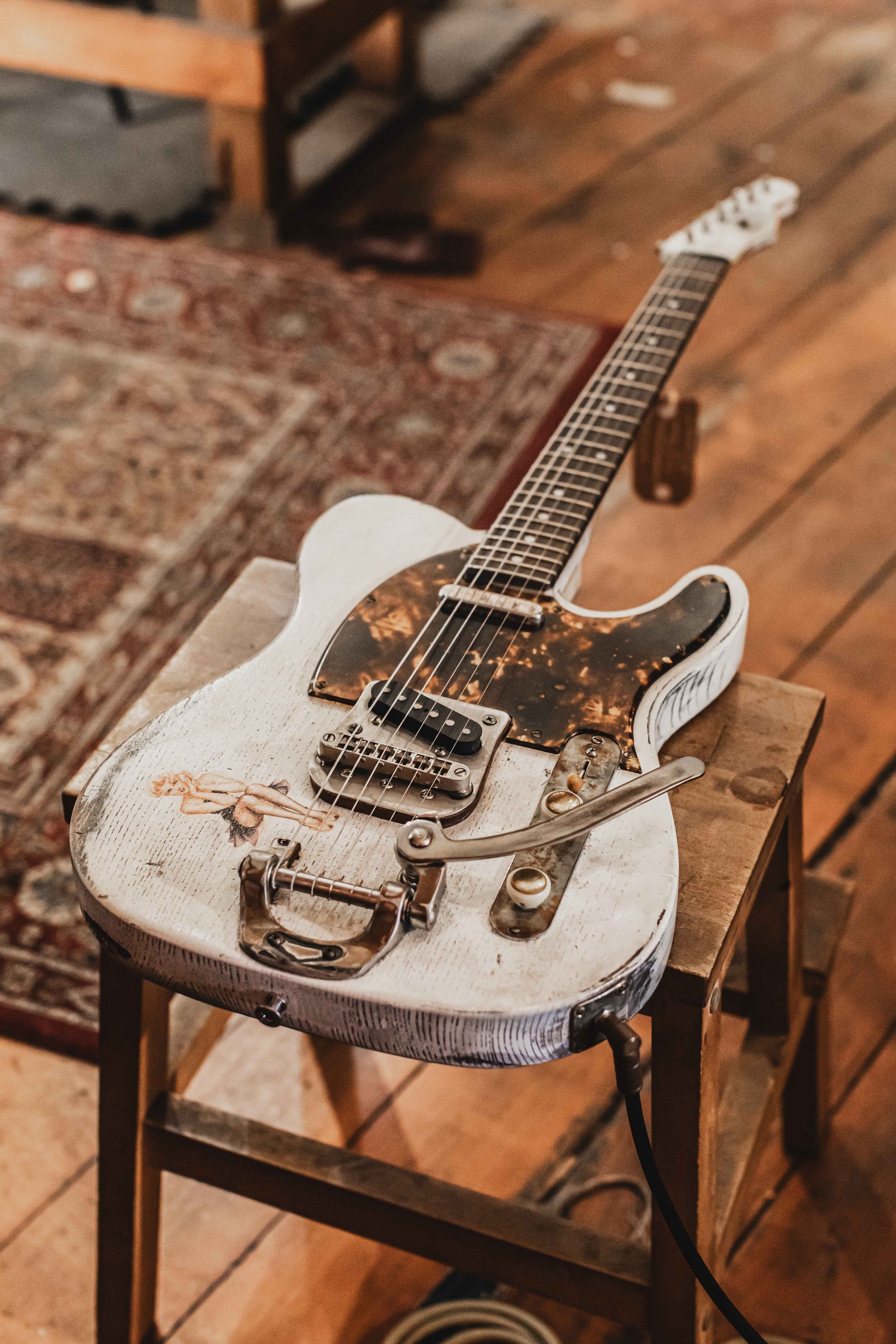
Here at the Guitar Repairers we just love anything old and vintagey so how could we go past those cute ol pinup girls from the 50’s? Printed onto waterslide decal paper, then transfered very carefully onto some choice guitars they definitely add a certain magic. So ask us about them if you enjoy the ol pinups and wanna give your strat that extra retro spark!
Custom Made Cases
This is a custom made case that regular Justin Ehrenreich made for his handmade Butterscotch Lapsteel. A fitted case is a luxury every guitar owner should get for his favorite guitar. Made to specifically fit your guitar, with electrostatic flocking and a durable outer shell, we just love these!!! So come on in and ask us about them
“Charlie Christian” Style Acoustic Pickups
We Love sound hole pick ups! I personally believe the LR Baggs M1 to be one of the most brilliant pieces of acoustic amplification technology to come out in the last 20 years. Our vintage parlor guitars however are a little different in their requirements. For one, many have sound holes that are too small to accommodate the commercially made products. Secondly, even when they can be fitted they tend to take away the antique vibe and look of the guitar. So we thought it best to come up with our own. This pick up has six calibrated pole pieces for even response, can be used with or with out an acoustic preamp and is compatible with our custom made piezo pick ups. RRP 175.00
Brazilian Bloodwood Nuts and Saddles
Disclaimer. The views expressed below are my views (Uncle Johnson). We will quite happily make you a nut and/or saddle in any material you like with the exception of compressed bat guana,
For the last few years I have been trying to find alternative materials for making nuts and saddles. The traditional materials such as bone and brass have been proven over time and the more widely used modern materials such as Corian, Micata and Tusq are also very good……So why do I want to re invent the wheel? Because…….
1. Bone makes the work shop smell like an industrial dentist’s surgery when shaped and sanded. I also find it very difficult to get a regular supply of consistently hard, non porous bone. The tone can sometimes be a little too bright and even bit harsh depending on the application, and lastly it can be quiet “sticky” when used to make a nut, thereby causing strings to “click” or “creak”. This can affect the tuneability and tuning stability of the instrument.
2. Brass attracts heat and burns my poor little fingers when I’m shaping it. I like it in certain applications and in some cases, as with bone I will recommend it. However, like bone it is quiet “sticky”.
3. Corian, Tusq and Micata are all wonderful materials, however I get a little worried for my health (not to mention my staff) when shaping it, as all these composite products smell kinda toxic.
Right then, this is what I had to ask myself.
1.The “new” material has to be super, super resonant.
2.The “new” material has to be hard as buggery and super long wearing
3.The “new” material slippery enough to allow easy string travel.
4.The “new” material has to be consistent
5.The “new” material has to be easy to shape
6.The “new” material has to make my workshop smell good and be, within reason, non toxic.
7.Lastly, it has to look good and make my clients happy so they keep coming back to me.
The material (Blood Wood) is an exotic timber from Brazil which has only become available in Australia in the last 12 months. Hearing is believing. Everyone of us in the workshop is amazed by this discovery. It has taken 3 years of experimenting to find it, however it has been worthwhile.
The “other” discovery we found is that by laminating the blood wood with ivory (slips) taken from the keys of donor pianos we get a gorgeous look nut or saddle with the combined benefits of both materials.
The Woodie
How could we resist these little wonders. They are very durable, very compact, and best of all they look fantastic. Yours for 35.00 and just to really add that final touch we can stain it for you in a myriad of different colours for an extra 15.00