Uncle Johns Famous String Goo

dscf9153

A  Top  Quality String Preserver

  • Unlike most string lubricants ours does not contain silicon or any other harmful lubricants, our product is all natural baby.
  • It neutralizes the pH value of sweat (the number one cause of string corrosion) so that you can get up to four times the life out of your strings.
  • One bottle should last you close to three years! (a few drops on a flanel cloth after every time you play is the recommended usage).
  • and it smells great!

Keeps strings fresh for up to 4 times their normal life. Harmless  ingredients  lubricate, clean,  fortify and protect your strings.

Each batch is bottled with high attention to detail and our product is quality reassured. Tried and tested by all of us here at the Guitar Repairers. So come in and pick yourself up one today!

The Luthiery Secrets of Restoration: EXPOSED!

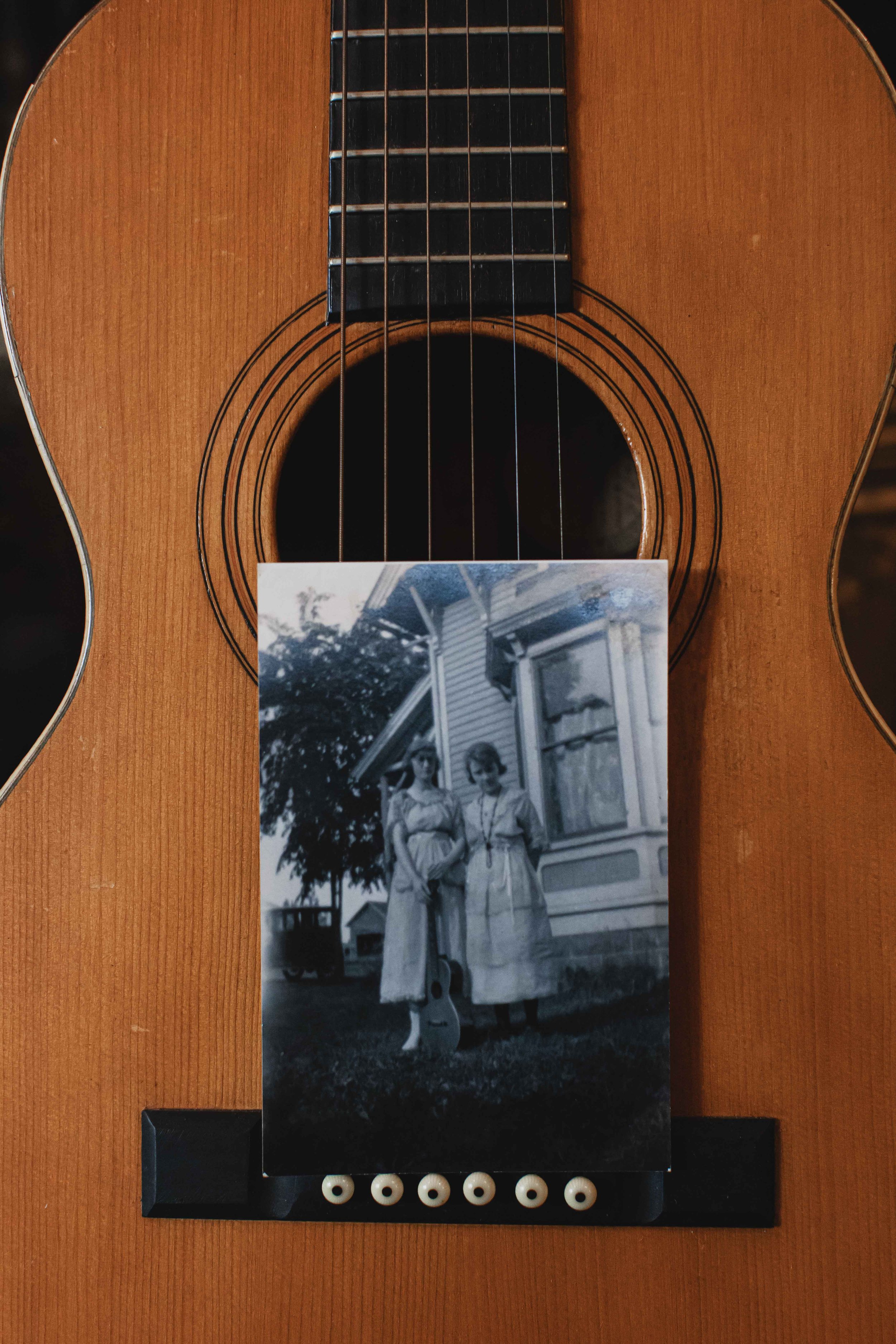
Restoring vintage and rare instruments is the driving passion behind us here at the Guitar Repairers. Seeing a beautiful old guitar from say the 1890’s restored to a playable condition is what makes all our hard work really pay off.

Why do we do it?

Well, from a luthiery point of view we restore old guitars because:

•    Older timber is much more resonant. Over time wood dries out and the dryer it is, the harder it is, causing it to resonate sound rather than absorb it. (even modern kiln dried timbre is not completely dried out)

•    The less moisture there is in wood the less it will move over time as well. Through seasonal changes new wood still warps and moves slightly. An older guitar has done all moving and warping so we’re left with a very sturdy instrument.
•    The timbers used in older guitars are of very high quality. Brazilian rosewood- the best quality rosewood- for example was once used almost exclusively in old guitars. It is now a protected species and can’t be used anymore. But often when we get an old guitar in we find that it has lovely brazilian rosewood back and sides.
•   They all have stories. Dings, dents, scratches and marks, these are all tell tale signs that a guitar has led an interesting life. Knowing that an old 1900’s parlour guitar from the US of A was once some young musicians bread and butter makes for a much more interesting history than some man named Django CMCing them from a factory in Moosejaw, Canada.

What do we do exactly?

The most common restoration job is as follows:

•    On old pre 1940’s guitars, of which we see many, they have ladder bracing. Ladder bracing was a suitable bracing if you were to string your guitar with gut strings. But with modern day steel strings the ladder bracings cannot support the high tension. So we remove the back, remove the ladder bracings from the soundboard and replace them with the modern x-bracing pattern. We use spruce obtained from century old German pianos so that the braces themselves are quite resonant and won’t move over time either.

Unrestored Harmony Sovereign original braces Back of guitar new braces

————————————————————————————————————————————————-

•    The bridgeplates of the old guitars are either worn out or wouldn’t be able to support the ball of the steel strings. So we replace the bridgeplate with a rosewood one.

New Braces

————————————————————————————————————————————————-
•    The next step is to replace any loose kerfing, re-glue any loose endblocks and then re-glue the back.

Spools galore

————————————————————————————————————————————————-
•    The bridge also has to be replaced more often than not. So Luke, our talented luthier makes rosewood bridges from scratch, complimenting the style and theme of the guitar.

almost done

————————————————————————————————————————————————-
•    Once glued on, the bridge then has to be drilled and the saddle slot routed.
•    If the guitar doesn’t have a truss rod or even a “steel reinforced bar”, which they often don’t, we have to remove the dovetailed neck from the body, shim or shave the heel and re-glue it back on. This is called resetting the neck.
•    If the neck doesn’t have to be reset then it usually has to be refretted. We remove the frets, sand a radius into the fretboard, install new frets, level and recrown them and polish them to a shine.
•    The machine heads also will often need replacing. So, to do that requires doweling the old holes and redrilling them. We then usually put on a set of vintage style machine heads that match and emphasize the original style of the guitar.

slotted headstock

————————————————————————————————————————————————-
•    Then we cut back the guitar and overspray it with vintage tint nitrocellulose lacquer to add a coat of protection and really bring out the grain and tone of the old timber.

————————————————————————————————————————————————-

•    By this point we’re almost done. Now come the intricacies of the setup. John makes, from scratch a nut and saddle, (made from brazilian bloodwood with a compensated nut). Then sets the action height, intonation, nut spacing, string tension, saddle width and overall playability to get the very best feel and sound out of the old girl.

Phew, and this is just a basic run down of what needs be done. Sometimes more work has is needed like fixing and cleating splits and cracks, hole repair, rethreading screw holes, making new scratchplates, replacing fretboards etc etc.

The End Result

What we have after these countless hours of sweat blood and tears is a beautifully old instrument that not only feels great to play but has a sound that is loud, resonant, clear and always a surprise at how well it comes out. A restored 19th century parlour guitar is louder and more vibrant than its modern equivalent.


So come on in and have a play yourself and see that there is no substitute for a restored vintage guitar. Unparalleled in its resonance, quality and structure and plays as easily as any modern guitar, our restorations are completely unique in style and sound.

Custom Made Cases

dscf8489 This is a custom made case that regular Justin Ehrenreich made for his handmade Butterscotch Lapsteel. A fitted case is a luxury every guitar owner should get for his favorite guitar. Made to specifically fit your guitar, with electrostatic flocking and a durable outer shell, we just love these!!! So come on in and ask us about them

Custom Girlie Decals

dscf8443 Here at the Guitar Repairers we just love anything old and vintagey so how could we go past those cute ol pinup girls from the 50’s? Printed onto waterslide decal paper, then transfered very carefully onto some choice guitars they definitely add a certain magic. So ask us about them if you enjoy the ol pinups and wanna give your strat that extra retro spark!

Employee’s Page now open!

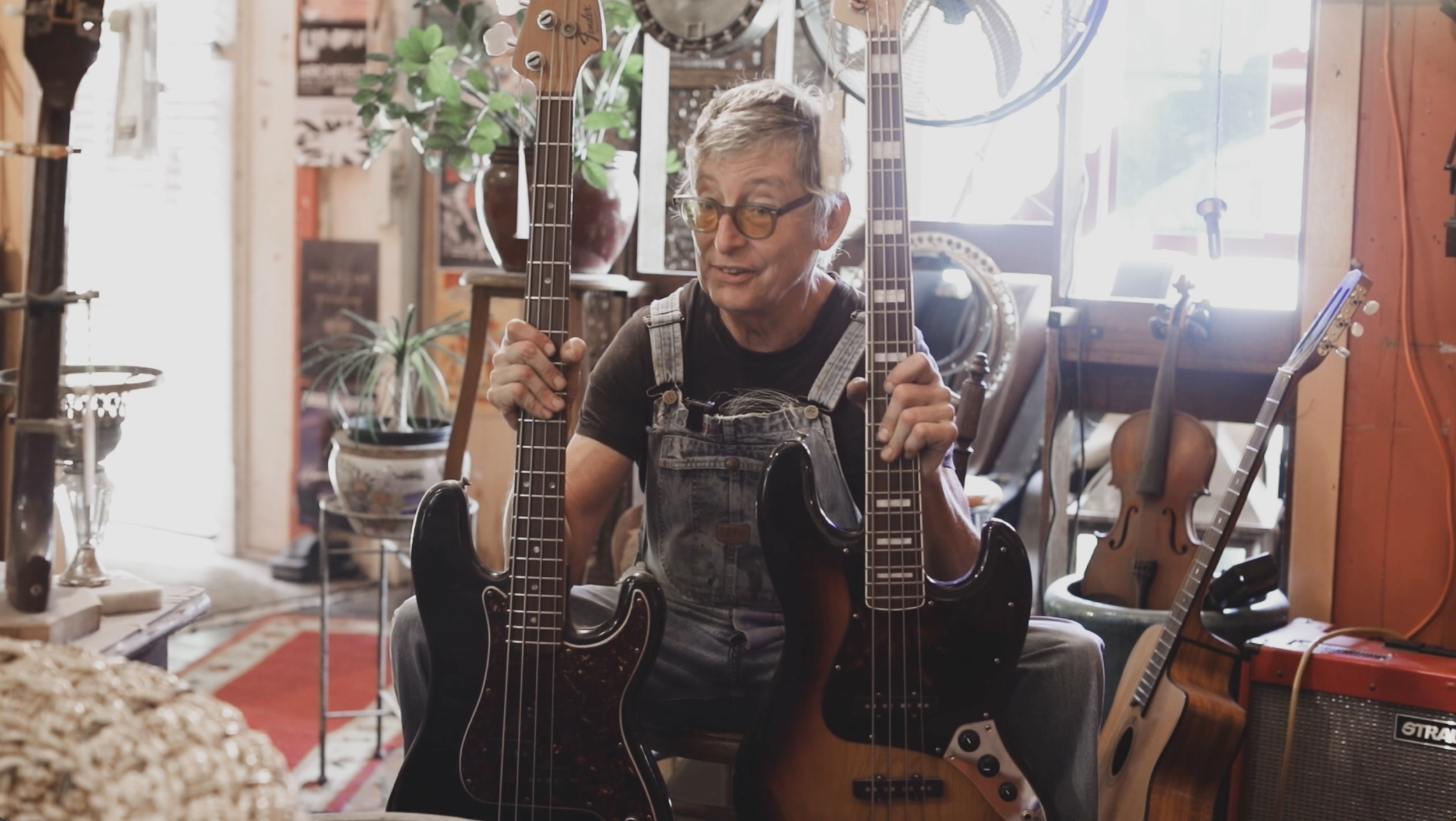
we finally got off our lazy asses and did the employees page. So now you can finally put faces to the craftsmen behind the work you see here, not that thats much of a consolidation…

stringgoo2 Uncle John’s Famous String Goo

The Goo with a gazillion uses! It’s a string preserver, string and hardware lubricant and polish for your acoustic or electric guitar, bass, mandolin, banjo, bozouki, sitar… WHATEVER!!!

It works by neutralising the corrosive, alkaline solution that is human sweat. As it does this it also coats the string protecting it from the harmful effects of oxidisation.

And this stuff actually works. It makes strings last up to 4 times longer.

RRP $25.00

“Charlie Christian” Style Acoustic Pickups

dscf8351 We Love sound hole pick ups! I personally believe the LR Baggs M1 to be one of the most brilliant pieces of acoustic amplification technology to come out in the last 20 years. Our vintage parlor guitars however are a little different in their requirements. For one, many have sound holes that are too small to accommodate the commercially made products. Secondly, even when they can be fitted they tend to take away the antique vibe and look of the guitar. So we thought it best to come up with our own. This pick up has six calibrated pole pieces for even response, can be used with or with out an acoustic preamp and is compatible with our custom made piezo pick ups. RRP 175.00

Custom Straps from Ireland

Aren’t they BOOODiful?! These hand crafted straps are the result of the many hours put into them by there maker John Regan. John is a very colourful character to say the least. Born in Galway, he immigrated to Australia where he made a success of himself as an actor (both stage and screen), the leader of legendary 60’s and 70’s rock band “Regan’s Rebels and proud father of one Scotty Regan of Brisbane musical institution “The Gin Club”. John returned to Galway a few years ago for the quiet life, however as you can see idleness is not something that comes naturally to him. Straps start at 125.00 with custom orders also available.

Brazilian Bloodwood Nuts and Saddles

Disclaimer. The views expressed below are my views (Uncle Johnson). We will quite happily make you a nut and/or saddle in any material you like with the exception of compressed bat guana,

dscf8132_rs For the last few years I have been trying to find alternative materials for making nuts and saddles. The traditional materials such as bone and brass have been proven over time and the more widely used modern materials such as Corian, Micata and Tusq are also very good……So why do I want to re invent the wheel? Because…….

1. Bone makes the work shop smell like an industrial dentist’s surgery when shaped and sanded. I also find it very difficult to get a regular supply of consistently hard, non porous bone. The tone can sometimes be a little too bright and even bit harsh depending on the application, and lastly it can be quiet “sticky” when used to make a nut, thereby causing strings to “click” or “creak”. This can affect the tuneability and tuning stability of the instrument.

2. Brass attracts heat and burns my poor little fingers when I’m shaping it. I like it in certain applications and in some cases, as with bone I will recommend it. However, like bone it is quiet “sticky”.
3. Corian, Tusq and Micata are all wonderful materials, however I get a little worried for my health (not to mention my staff) when shaping it, as all these composite products smell kinda toxic.

Right then, this is what I had to ask myself.

1.The “new” material has to be super, super resonant.
2.The “new” material has to be hard as buggery and super long wearing
3.The “new” material slippery enough to allow easy string travel.
4.The “new” material has to be consistent
5.The “new” material has to be easy to shape
6.The “new” material has to make my workshop smell good and be, within reason, non toxic.
7.Lastly, it has to look good and make my clients happy so they keep coming back to me.

The material (Blood Wood) is an exotic timber from Brazil which has only become available in Australia in the last 12 months. Hearing is believing. Everyone of us in the workshop is amazed by this discovery. It has taken 3 years of experimenting to find it, however it has been worthwhile.

The “other” discovery we found is that by laminating the blood wood with ivory (slips) taken from the keys of donor pianos we get a gorgeous look nut or saddle with the combined benefits of both materials.

Woodie Guitar Stands

dscf8216_rs How could we resist these little wonders. They are very durable, very compact, and best of all they look fantastic. Yours for 35.00 and just to really add that final touch we can stain it for you in a myriad of different colours for an extra 15.00

Compensated Nuts

dscf8246_rs Ever driven yourself insane trying to get the open chords of your guitar to all play in tune and then once you’ve found an acceptable compromise you find the bar chord suck ass? Well this can help. When you look at your guitar, do you notice that the bridge saddle/s are further away from the neck on the bass side and closer to the neck on the treble side? This is called compensation and it is designed to compensate for the thickness of the strings so that they are as close to being a perfect octave at the 12th fret. The 1000,000.00 question is how do you get them to be in perfect pitch over the rest of the finger board? Answer. You can’t, OR…….you can if you intend having individually calibrated frets for each string (that’s roughly 132 mini fret lengths). And that isn’t easy to do, although I really would love to try one day. Now having said this, I would be remiss if I didn’t point out that a little bit of dissonance is not a bad thing in any musical instrument, because without dissonance you would not have tone (wanna know more? Please ask). Now back to the compensated nut. It works in the same way as the bridge saddle/s, only it does it from the other end. Now there has been an upsurge of interest in this type the nut mainly through the marketing of several companies claiming to have virtually invented it themselves. Sorry fellas, no disrespect but luthiers going back as far as the 17th century were applying the same idea to gut stringed instruments. Musicman and ESP also have this concept on many of their guitars. The nut is especially useful for those folks who like to use a capo and also you metal heads who love nothing more than a guitar tuned down to B. The average price of this modification is 75.00 and for many it will be money well spent.

Handmade Brass Saddle Bridgepieces

Bridge Span Saddle Pieces Up until recently we, like most guitar repair shops replaced bass saddles and telecaster bridge saddles with the best bridge saddles we could find. However I’ve never been that happy with the type of brass used, nor the tone it produced. I researched the historical “why’s” and “where fores” of this and found the most interesting thing. The original brass used by the likes of Fender back in the 50’s was actually a softer compound than that which is available today. This softer brass was cheaper and more available in post war USA owing to the on going rationing in the mineral resources sector. Now here’s another even more interesting thing. The brass “D” mould strips used in old European Piano’s are also a softer type of brass…..Do you see where I’m going here? The softer compound actually gives more sustain, has a woodier, warmer tone and best of all we’re all doing the planet a favour. These saddle sets are on average 140.00 plus fitting

Hello! and Welcome to the Guitar Repairers

theguitarrepairerssign Welcome Guitar Geeks, to our humble online abode.

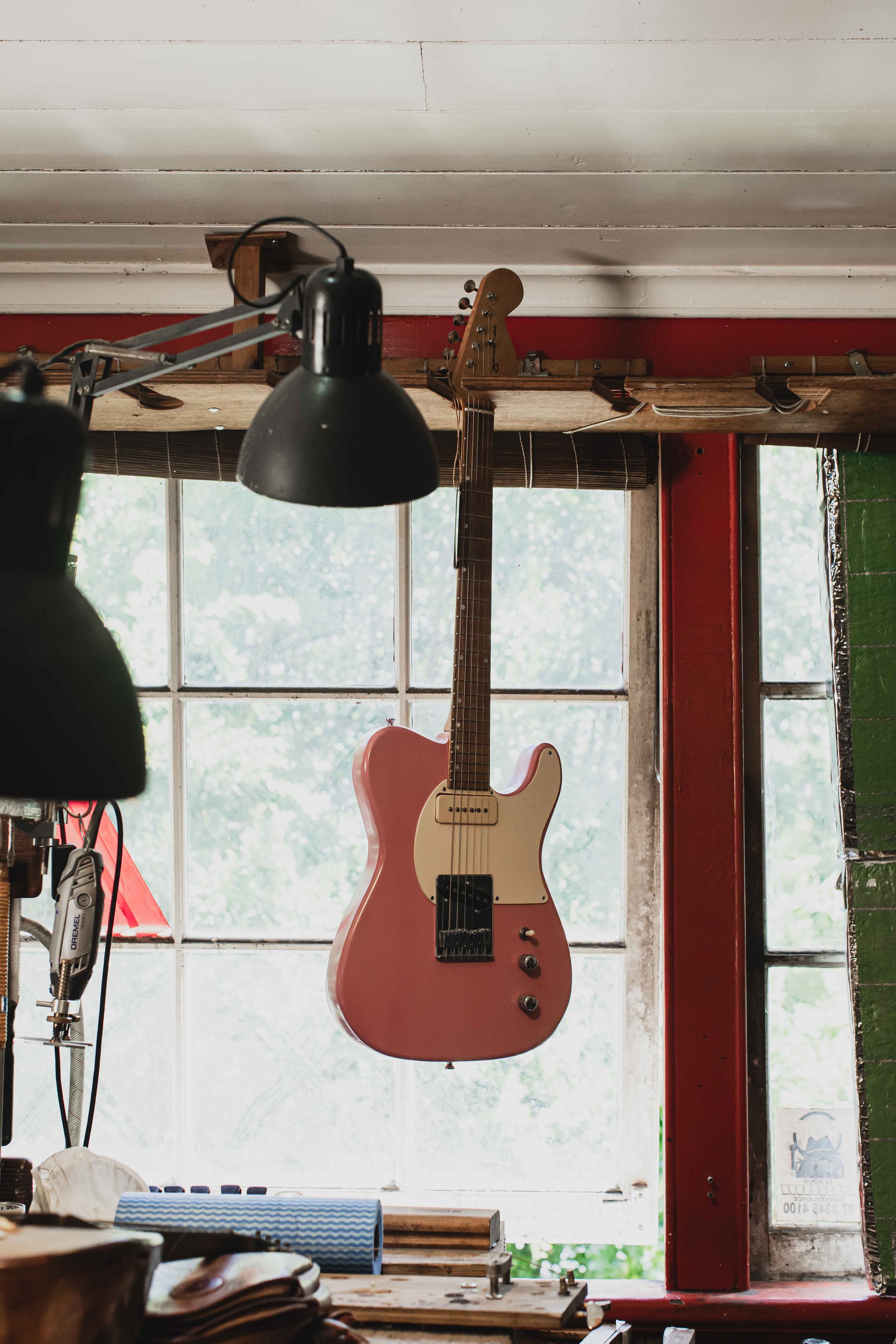
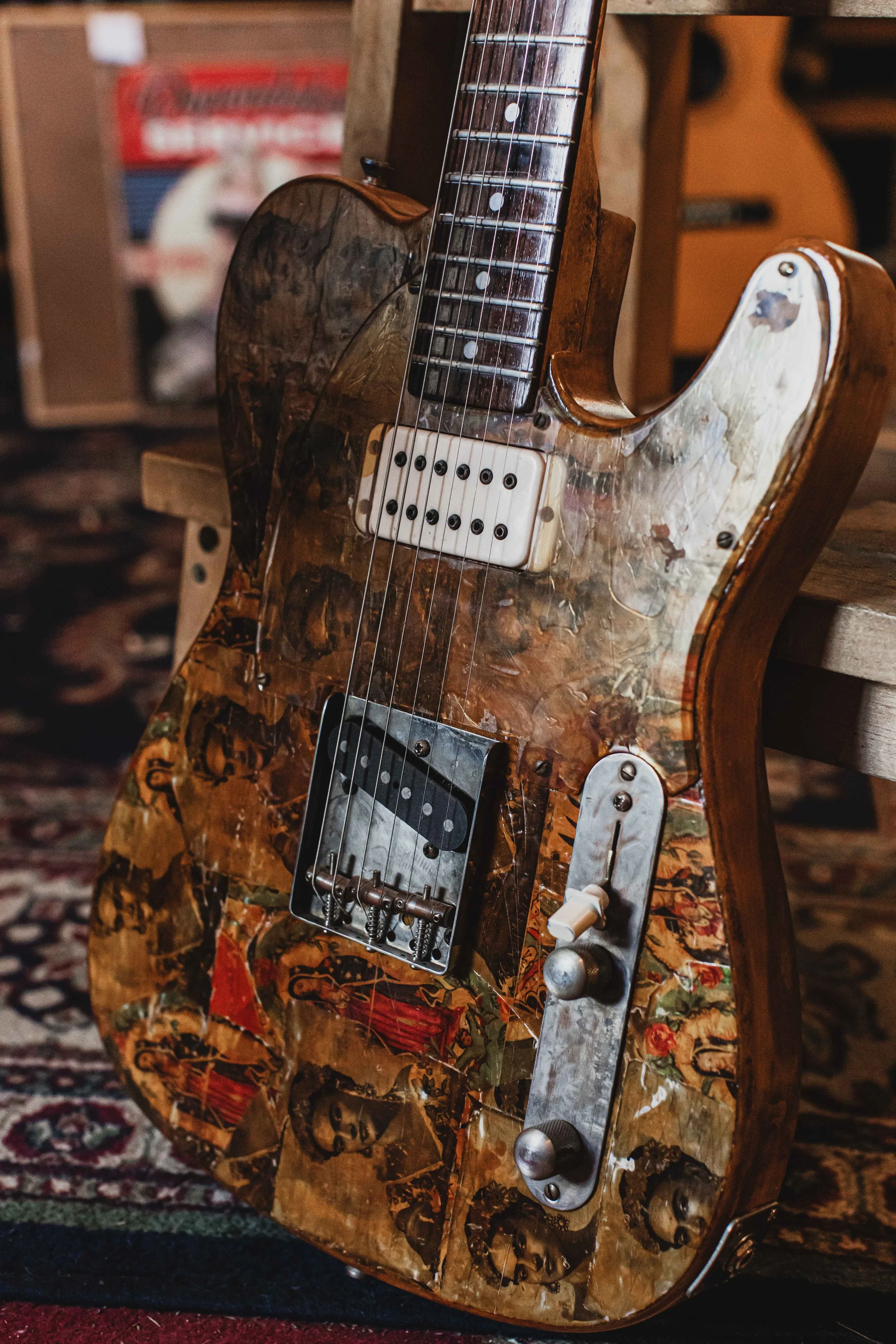
Here you will find the widest range of vintage, restored, repaired, reloved and revived stringed instruments. From 1890 parlor guitars to our brand new Custom Wallpaper Tele’s, we got it all. Check out our Guitars, Banjos, Mando’s, Ukuleles, Basses, Solid Body’s, Hollowbody’s and a wide range of Pencil Crayons. Click the about us pages to see a little of our story so far, our friends page to see who we rub elbows with and of course take a look at all our fancy stringed things. Don’t forget to check out our FAQ section for bunch of answers to common repair questions and our products section to see the vast range of different products and materials that go into making and restoring guitars to top notch condition. and if all this isn’t enough for you then

visit the old site here

Back Bow Partial Refret

What is a Backbow Partial Refret?

Of all the repair and restoration work we do here Back-Bow Levels and Back Bow Partial Refrets would have to be one of the most common jobs.

We do a backbow partial refret if:

•    The first few frets are worn very low due to constant playing.
•    The angle of the neck to the body is too acute. So instead of resetting the neck, a back-bow partial refret is a cost   effective solution.
•     The neck is in a sharp up bow and it will take more than just a Backbow Level to fix the problem.
•    Necks warp and twist for a variety of reasons and if a backbow level is not enough then a backbow partial refret can be.

So here is what we do and how it works

•    We take the neck and tighten the truss rod slightly putting it into a backbow. Now, if we were to level the frets flat so that the 1st fret was as high as the 12th fret we would be filing the 12th fret down to nothing

backbow-diagram

To counter this we re-fret the first seven frets so that they can be  level. (The above diagram is exaggerated for clarity).

The benefits of Backbow Partial Refret are:

•    A lower action without any fret buzz
•    The strings will now play and sit at the correct angle to the body, giving a nice even action.
•    Longer fret life for those hard hitters.
•    The frets will all be nice and level.
•    A more even and accurate intonation.

So there you have it, ancient luthiery secrets finally exposed! If you are experiencing

•    Buzzing frets
•    “dead spots” on your guitar where the guitar plays the note in front of the fretted note
•    Flat spots or flat, worn frets
•    Uneven intonation
•    Super high action
•    “choking out” of the frets in the upper register

Then a Backbow Level or Backbow Partial Refret could be just what you need. So bring on in your guitar and we’ll be happy to have a looksie at it.

Uncle John’s Famour Tortoise Shell

Uncle John’s Famous Tortoise Shell

So our boys Matt and Luke got funky with some clear perspex and a host of nitro cellulose / stain mixtures to create the tortoise shell delights you see before you.
We even utilised the stuff in one of our banjo pick-up systems (see photo), with pleasing results.

Scratchplates and many other accessories are made to order. This is just a sample of what we can do.

We started creating our custom tortoise shell creations for a couple of reasons. Firstly, it is very difficult to import tortoise shell as it is flammable, and secondly we have been increasingly unhappy with the range of tortoise shell scratchplates available, we feel they just don’t do a fine classy instrument justice.

takamine12tort matoneg545tort johnsonstrattort harmonyuketort gibsonheritagetort

Next Page »